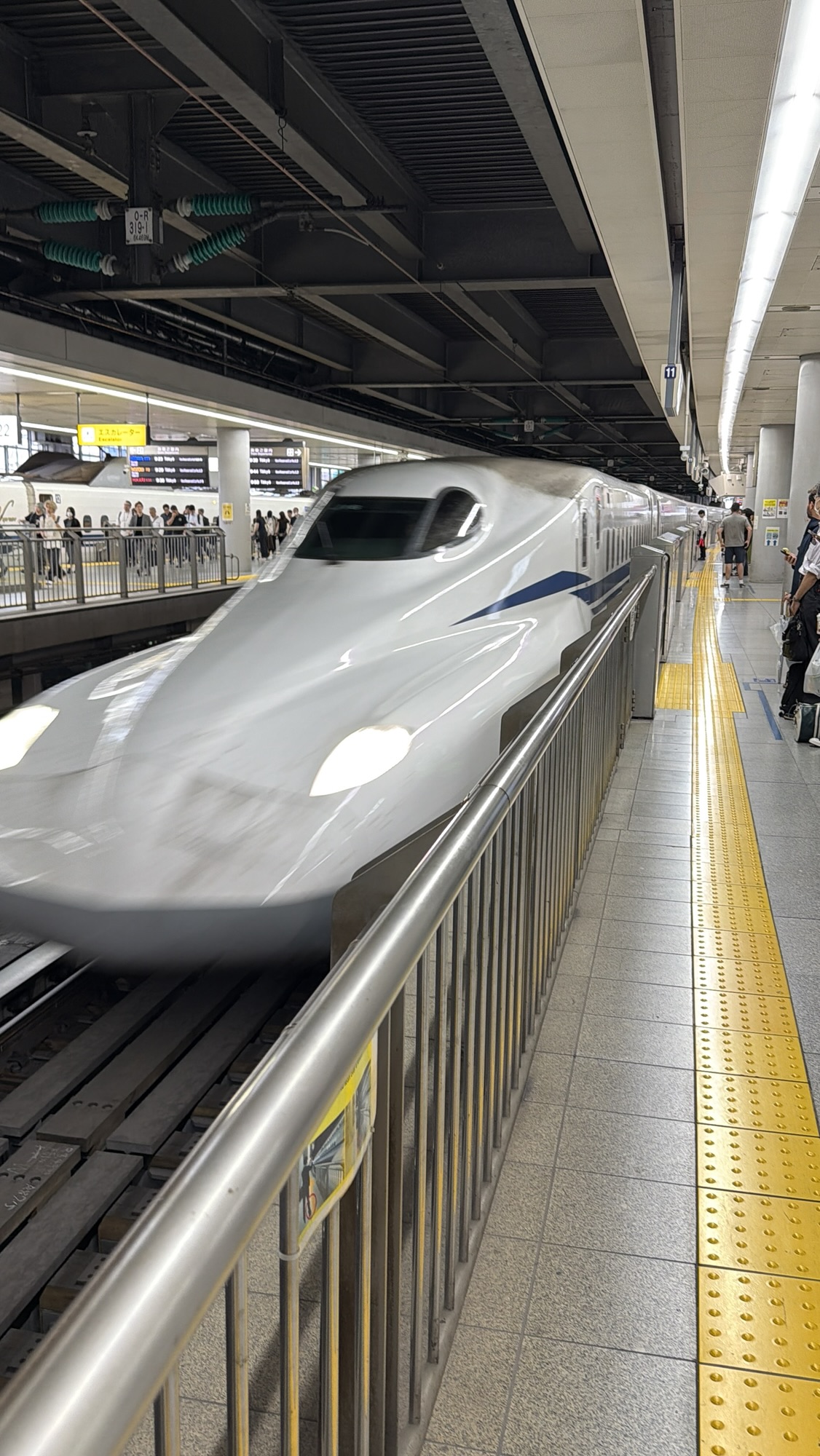
After three days in Tokyo, it was time to trade the neon glow, skyscrapers, and Shibuya sized crowds for temples, markets, and the winding streets of Kyoto. We had tickets on the 10:01 Nozomi Shinkansen from Shinagawa Station, and because we were not entirely sure where we were going, how the boarding process worked, or what would happen if we missed a train that departed precisely on schedule, we arrived early. Very early in fine “Dad” fashion. In retrospect, probably unnecessarily early. Japan’s train system is very precise, but also very easy to navigate.
Arriving early at the Shinkansen in Shinagawa Station gave us time to shop for our lunch onboard. Shinagawa Station had an almost overwhelming assortment of beautifully packaged bento boxes, each looking more elaborate and delicious than the last. We wandered among them comparing grilled meat, fish, rice, vegetables, pickles, and mysterious little compartments filled with potential surprises. Eventually we each selected whatever looked best and headed for the platform. We had reserved seats in the Green Car, Japan’s first class version of the Shinkansen, and specifically chose seats on the right side of the train in hopes of seeing Mount Fuji along the way.


The deluge of rain that had soaked us at Ueno Zoo the previous day had eased, but Tokyo was still wrapped in steady gray rain and low clouds. Somewhere out there, Mount Fuji was presumably magnificent, but she was having none of us today. Instead, we settled into our comfortable seats, opened our bento boxes, and watched Japan streak past the windows. The Nozomi Shinkansen reaches speeds of 285 kilometers per hour, about 177 miles per hour, but the ride is so smooth that there is almost no sensation of moving that fast. The only giveaway is the scenery. Bamboo covered hills appeared through the mist, followed by rice fields and farmland, then clusters of houses and industrial towns punctuated by factories carrying both familiar and unfamiliar names. Anything close to the tracks was a blur, so we set our focus on the distant landscape to avoid any motion sickness.


A little over two hours later we arrived in Kyoto, and realized our decision to forward our bags turned out to be brilliant. The day before, we had used Japan’s luggage forwarding service to send our suitcases ahead, which meant we stepped off the Shinkansen carrying a lighter load. Our hotel didn’t look terribly far away on the map, so we decided to walk. The rain had mostly retreated to a drizzle, and the route immediately took us away from the scale of Tokyo and into narrow streets, tiny alleys, low buildings, little shops, bicycles, gardens, and twists and turns that make you want to see what might be around the next corner. By the time the drizzle began turning back into rain, we could see our hotel. We slipped inside just before we got too wet.
Genji Kyoto was our home for the next 5 days, a beautiful boutique hotel sitting directly along the Kamo River. The hotel takes its inspiration from The Tale of Genji, the monolithic 11th century Japanese novel that has inspired Japanese art and culture for a thousand years. Each of the hotel’s 19 rooms includes artwork drawing from themes in the book, while the architecture incorporates elements of traditional Kyoto machiya townhouses, interior gardens, tatami spaces, and views toward either the river or private gardens. Additioanlly, interior designer Jun Tomita custom designed almost every piece of furniture specifically for Genji Kyoto. Clara and Ian scored a beautiful upgraded garden suite on the first floor, while Tawny and I ended up in a smaller room, but on the top floor overlooking the Kamo River. From our room we could look down at the water and watch herons and storks stalking around in the shallows. It seemed like a pretty good trade.


Once we had settled in, we headed back outside for our first real exploration of Kyoto. The rain had returned, but after the previous day we had recalibrated our definition of rainy. Being from Seattle, this barely qualified as rain. The bigger challenge was the humidity. The air was extraordinarily still, warm, and heavy, wrapping itself around you like the hot wet towel you get in business class before meal service the moment you stepped outside. We grabbed a short cab ride to Yasaka Shrine, our first Kyoto shrine and the beginning of what promised to be many. Kyoto is sprinkled with more than 2,000 temples and shrines, so you could spend weeks here and still barely make a dent. Yasaka was an excellent introduction, with its lanterns, gates, shrine buildings, worshippers, tourists, and the unmistakable feeling that we had crossed into a very different pace of Japan from the one we had left that morning.


From Yasaka we wandered into Gion, following whatever alley or narrow street looked interesting. This was quickly our preferred Kyoto navigation technique. The neighborhood was a maze of traditional buildings, restaurants, small hotels, shops, wooden facades, hidden courtyards, and mysterious streets. Kyoto was beautiful in a way Tokyo was not trying to be. Tokyo is a beautiful spectacle. Kyoto invited you take pause and look closer.


Eventually the rain picked up again, so we drifted toward one of the larger shopping streets, passing the familiar international brands before ducking into Teramachi to get out of the rain which had started again. Everything immediately became more interesting. The covered arcade seemed to go on forever, lined with smaller boutiques, shops, and restaurants. Clara found a shop where she had a personal stamp made with her name in Japanese characters. We also came across a one of Kyoto’s 2000 shrines, which was a small shrine swallowed by the shopping mall around it, a wonderful reminder of how the ancient and modern coexist in Japan like no place else I’ve been.


Then Teramachi intersected with Nishiki Market and as we entered the trip suddenly became all about food. Nishiki is essentially a long, narrow corridor of edible temptations. Vendors were selling seafood, sweets, pickles, tea, grilled meats, dumplings, vegetables, and several things that required more bravery than we could muster. The famous Tako Tamago (tiny octopus and egg on a stick) immediately presented itself as a dare. We selected truth and moved onto the Wagyu. Wagyu required no courage whatsoever. One stall was grilling skewers to order, and we bought one with four pieces so we could each have a bite. It was expensive, rich, fatty, and fantastic. A few doors later we discovered another vendor selling even more expensive A5 wagyu. Ian couldn’t resist, so we bought another skewer and divided that one into four bites too. At this point the evening’s dinner strategy was obvious. There would be no restaurant. We’d simply eat our way through Nishiki Market until we were full or the vendors ran out of food or closed.


Next came enormous fried vegetable nests that reminded us of the little frozen ones we sometimes buy at Trader Joe’s, except these were the versions Trader Joe’s vegetable nests dream of becoming when they grow up. We added gyoza, then sugar glazed strawberry and grape skewers, then fish shaped taiyaki filled with combinations of red bean paste, custard, butter, and other delicious things. Naturally, we tried several. Nishiki was less market and more progressive dinning.
Unfortunately, Nishiki keeps earlier hours than us. By somewhere between five and six, shutters began coming down and vendors started cleaning up. Our roaming dinner was over, so we began wandering back toward the hotel without any particular route in mind. The rain had finally stopped, but the warm humidity remained, and Kyoto had begun illuminating itself for the evening. Eventually we found a small restaurant and bar overlooking the Kamo River and grabbed seats outside. Below us, people walked along the riverbanks while a heron stood in the water fishing, teaching us a thing about patience. The city lights reflected off the river, drinks arrived, and for a while we just sat there watching Kyoto go by.
Our feet were fully angry with us. Tokyo had already put several days of damage on them (we all had blisters), and Kyoto showed no indication to be kinder. We started the final walk back to the hotel when, tucked along the way, we discovered something we had somehow not yet encountered in Japan: a liquor vending machine. Obviously, this required investigation. A few button presses later we had acquired several of our increasingly beloved lemon sours and a Suntory highball.


We carried our vending machine bounty back to Genji Kyoto, watched the Kamo River flow past below our window, and called it an early night. In the space of a single day we had traveled across Japan at nearly 180 miles per hour, eaten lunch from a box at bullet train speed, wandered through our first Kyoto shrine, disappeared into Gion’s alleys, shopped beneath the covered arcades of Teramachi, eaten our way through Nishiki Market, and ended the evening drinking canned cocktails beside the river. Not bad for a travel day. And tomorrow, Kyoto was going to make us earn those comfortable beds and foot aches all over again.



Leave a Reply