After Osaka Castle, our CupNoodles customization, and ramen for lunch, we headed toward Osaka Bay and the Osaka Aquarium Kaiyukan. We had heard great things about the aquarium, particularly its whale sharks and its enormous central tank, and since the rain was still coming down, an aquarium seemed like about as perfect a rainy day activity as any. Apparently, everyone else in Osaka had come to the same conclusion. We arrived with umbrellas overhead only to discover that the next available admission time was an hour away. Kaiyukan is one of Japan’s largest and best known aquariums, with around 30,000 creatures representing roughly 620 species. It focuses its exhibit on the Pacific Rim with tanks taking you around the world. However, at its center is the Pacific Ocean tank, an astonishing 9 meters deep (~30 feet), as much as 34 meters long (~111 feet), and containing 5,400 tons of water!


With an hour to kill, we ducked into the adjacent Tempozan Marketplace beneath the enormous Tempozan Giant Ferris Wheel. We had an interim mission, so save our feet. We went hunting for Band Aids and blister supplies at a drugstore.
An hour later we were finally inside Kaiyukan. The aquarium is beautifully designed. We passed Asian small clawed otters, colorful fish from across the Pacific Rim, Pacific white sided dolphins in the Tasman Sea exhibit, and California sea lions, including two babies born earlier this summer. There were also seals so spectacularly rotund that they appeared to nearly be complete spheres. Then came an escalator ride up, and up, and up, until we reached the eighth floor. From there, the entire aquarium essentially sends you on a slow spiral downward through the Pacific Ocean. We rounded a corner and saw them.Whale sharks.


No photograph or video really prepares you for how enormous they are. The two at Kaiyukan are named Kai and Yu. Kai, the male, is 5.3 meters long (over 17 feet) and weighs an estimated 1,100 kilograms (~2425 lbs), while Yu, the female, measures 6.2 meters (over 20 feet) and weighs an estimated 1,800 kilograms (nearly 4000 lbs!). They seemed impossibly large, and yet they moved with an effortless grace that made everything else in the tank appear hurried. We stood there for a long time just watching them glide past, disappear into the blue, and then slowly materialize again from somewhere on the other side of the tank. And then we realized that the tank was not just another exhibit. It was the aquarium.


From the eighth floor, the route begins a long, gradual descent around this colossal column of water. With every turn, you see the same ocean from a slightly different depth and perspective. Near the top we watched the whale sharks cruising close to the surface. As we descended, different creatures began appearing around them. Sharks. Hammerheads. Manta rays. Stingrays. Huge schools of fish. An enormous ocean sunfish! It looked like a first draft of an ancient fish, incomplete. Every corner revealed another view, and the farther down we went, the deeper into the ocean it felt like you were traveling. It was one of the most impressive aquarium designs we’d ever seen. Rather than moving from exhibit to exhibit, you descending through one.
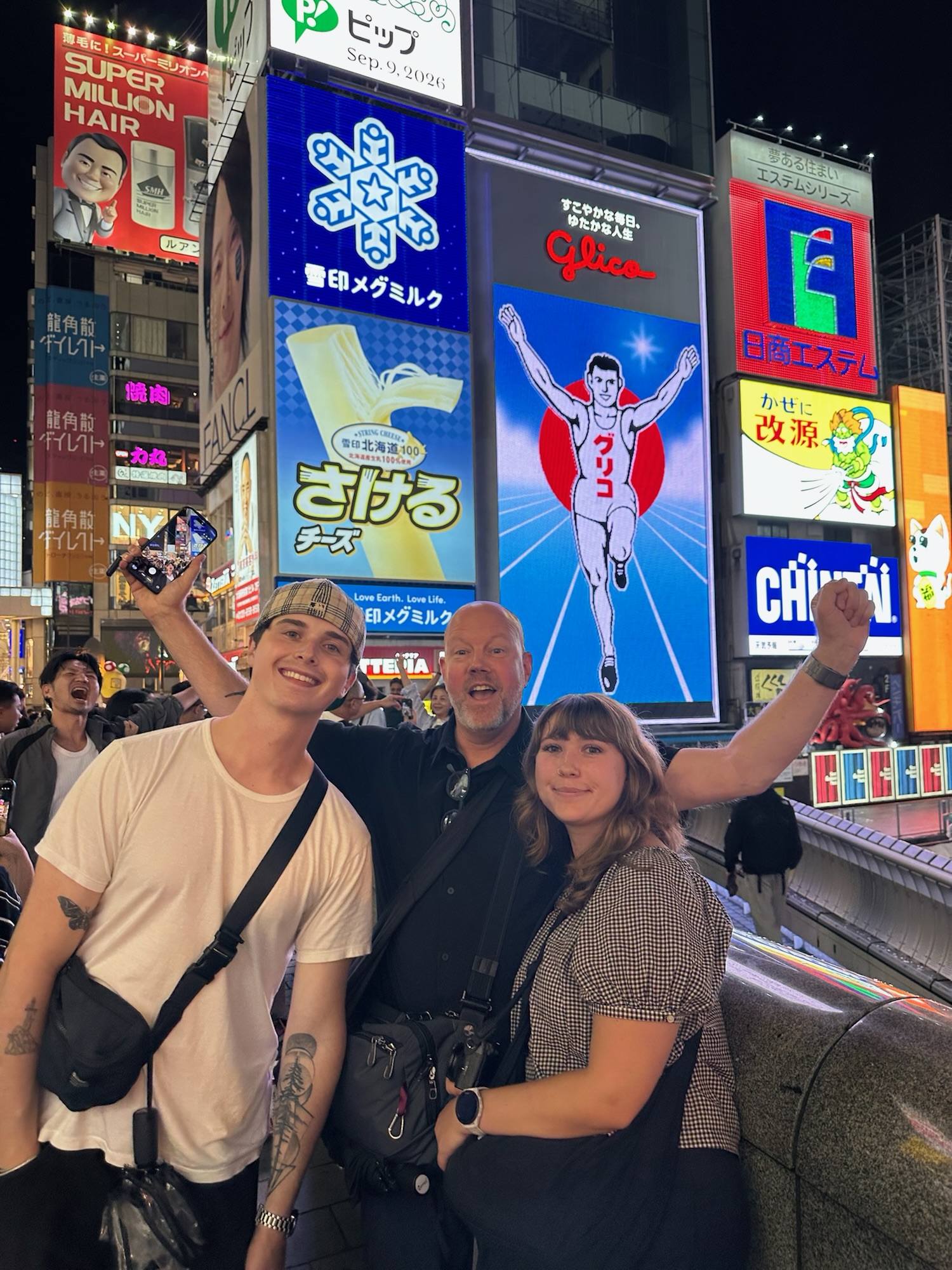
A few hours disappeared almost without our noticing. By the time we finally emerged, evening was setting in, the rain had stopped, and our itinerary still had more adventures. We headed toward Namba and entered the covered Ebisubashi-suji shopping arcade, which stretches north toward one of the most recognizable sights in Osaka, Ebisu Bridge and the giant Glico running man sign. The rain stopping had acted as a citywide signal to go outside, because Osaka had come pouring out into the streets. It was Wednesday night and the arcade was wall to wall humanity. We pushed our way through the crowd until we spilled out onto Ebisu Bridge, where the glowing Glico runner loomed over Dotonbori.


Below us was the Dotonbori River, packed with sightseeing boats cruising beneath the lights, while enormous animated signs and glowing billboards fought for attention on every building around us. We wandered along the riverwalk for a while, watching boats glide beneath the bridges. It felt a little like a Japanese Venice meets Time Square that had evolved into one of Japan’s great food and entertainment districts.


Across the river we walked toward yet another Don Quijote. After surviving the seven circles of Don Quijote hell in Shibuya, we thought we had seen it all. We had not. The Dotonbori Don Quijote has attached a Ferris wheel to the outside of the building. The Ebisu Tower rises more than 77 meters (over 250 feet) and carries gondolas around the exterior of the store. Riding it had actually been on our rainy day bucket list, but it was not operating that evening, and at this point we were running out of both time and energy. We were hungry.


Osaka is famous for Okonamiyaki, and there was no way we were going to leave without eating it. But Dotonbori was absolutely packed. We began wandering through the smaller streets and alleys behind the main Dotonbori chaos, poking our heads into one place after another. It was already around 8:00 p.m., and we still needed to get back to Shin Osaka Station and catch a late Nozomi Shinkansen to Kyoto. We were starting to consider giving up when Tawny noticed a tiny teppanyaki and okonomiyaki restaurant at the back of an alley.
There were only two tables and a handful of seats along the counter. Perfect. We squeezed in and, almost immediately, the little restaurant became one of our favorite meals of the entire trip. We finally got the grilled ginkgo nuts we had been searching for since seeing them in Omoide Yokocho back in Shinjuku. Then came asparagus wrapped in an irresponsible amount of bacon, with an entire slice wound around a single stalk and grilled until the bacon was crisp and the asparagus tender. It was ridiculous, decadent, and magnificent. But the star was the okonomiyaki.


Osaka style savory pancakes came to the table sizzling on the grill, packed with cabbage and pork goodness, then dressed with saucy ribbons of mayonnaise. Finally topped with bonito flakes scattered across half of the top where the heat caused them to writhe and squirm as though the entire pancake had come alive. The first time you see bonito flakes dancing on an okonomiyaki, it may be off-putting and it is an acquired taste, but Ian and I were in. And then we ordered another one. An another.
We ate until stuffed, paid our bill, thanked the people at our wonderful little restaurant, and headed back toward Shin Osaka Station. Soon we were aboard the Nozomi, racing through the darkness toward Kyoto at nearly 180 miles per hour.

Osaka had been wet, windy, crowded, chaotic, colorful, delicious, and completely wonderful. We see why our friends had recommended it and said we should spend more time there. We didn’t have the time, but now we have a reason to go back.
Goodbye, Osaka. We barely knew you. But we loved you. You certainly knew how to show us a good time on a rainy day.


Leave a Reply