
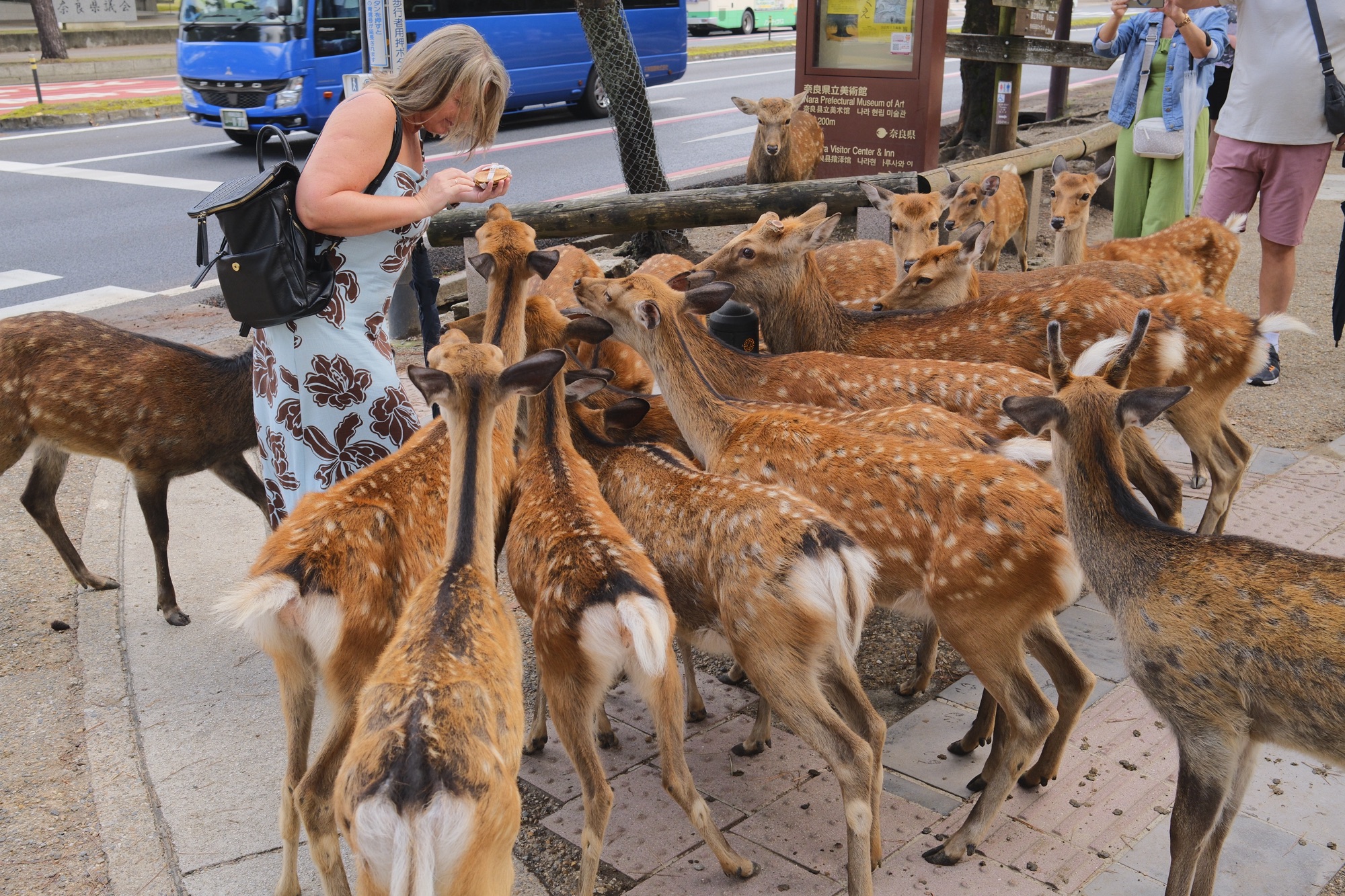
Around the time we were planning our Japan itinerary, Clara mentioned that she wanted to go to Nara. I wasn’t familiar with it, but apparently the deer of Nara had become social media sensations (#deerofnara), popping up all over Instagram and TikTok as visitors bow to polite Japanese deer who bow back before accepting a cracker. Sure, I thought. We could devote a day to something Gen Z was into.
Then, completely independently, Nara came up in another context. I had come into possession of some of my paternal grandmother’s belongings, including an her travel diary from 1935. At the age of twenty six, she set off alone and traveled around the world aboard a series of steamships. As I began reading her diary, I discovered something I had never known. She started her journey in Japan. Even more remarkably, while staying in Kyoto in July of 1935, she took day trips to both Nara and Osaka. Ninety one years later, we were doing exactly the same thing!

Suddenly, our trip to Nara had become more than a social media photo op with deer. We were following in my grandmother’s footsteps.
I had assumed that feeding deer in Nara was a tradition that went back perhaps a hundred years, but I soon learned that Nara was Japan’s capital from 710 to 784, (known as the Nara Period) and remains home to some of Japan’s oldest and most important temples, shrines, and sacred places. Visitors and pilgrims have been coming here for more than 1,300 years!
There would be no Nozomi Shinkansen zooming us there in twelve minutes like Osaka. We took the Kintetsu from Kyoto which was still an easy train ride of around forty minutes. We arrived early to clear skies, a welcome development after clouds of rain that have followed us around Japan. We stepped out of the station and simply followed the herd of tourists toward Nara Park.


As we left the station, signs began explaining the ground rules for deer engagement. The deer started materializing around us. First one. Then three. Then ten. Soon they were everywhere, wandering sidewalks, lounging beneath trees, crossing paths, and commingling amongst the people bowing and begging for crackers. There are more than a thousand wild sika deer living around Nara Park, and according to the history of Kasuga Taisha, the deity Takemikazuchi arrived in Nara riding a white deer. The deer became revered as sacred messengers of the gods. They are protected wild animals in Japan.
The currency between people and deer in Nara is a formal Japanese bow, and the shika senbei, a simple cracker made from wheat flour and rice bran and sold throughout the park for ¥200 (about $1.25). The tradition dates back centuries, and feeding the deer is considered a way for visitors to interact with the divine. Over the years, the deer also learned that if you bow to them they will bow back, expecting a cracker. The unspoken rule is courtesy first, cracker second. But it doesn’t always work that way.


We could see where the crackers were being sold because there was a herd of deer surrounding the vendor. Our challenge was buying crackers without alerting every deer within fifty meters you had just bought crackers. One woman nearby made the mistake of opening her bundle in the middle of the herd. The deer converged and she was quickly overwhelmed by wave of deer like a furry Great Wave of Kanagawa.
We attempted our own cracker purchase with more discretion. However, Clara yelled out “Dad!” and I turned to discover a deer had pulled my portable bottle of Purell hand sanitizer off my bag. Before I could react, Clara grabbed it directly out of the deer’s mouth. It was actually quite a tense scene and it seemed like a good idea to move away from the herd before opening our crackers. Deer were already nipping at us.
We left the sidewalk and moved farther into the park, where the deer herd thinned out. This was much more our speed. We would find an isolated deer, perhaps a doe or a fawn, bow gently, receive a bow in return, offer a cracker, and move on before word got out. It was lovely. The deer were beautiful and cute, the park was green and peaceful, and the routine was charming. It was also entertaining to see some of the TikTok and Instagram influencers trying to set up tripods and cameras in one location and being overwhelmed with herds.


Even in the park the deer were still a little aggressive and we had to feed one and quickly walk away. We went to the edge of the park and found a broad path through the trees. From there we continued away from Nara Park, where the landscape changed from open fields to a broad wooded path lined with stone lanterns, and fewer deer.
The deer here seemed calmer. One large buck was sitting beneath a tree, completely uninterested in the cracker economy around him. Tawny approached him gently. Eventually he stood, walked toward her, and stopped with a small ditch separating them. Tawny bowed. The buck bowed. She gave him a cracker. It was precisely the deer encounter we had imagined when Clara first suggested Nara. It was nice.


At almost exactly the same time, however, Clara had been feeding another large buck on the path behind us.


After Clara gave it one cracker and said no more, that buck began wandering toward Tawny. Without realizing it, Tawny was now standing between two adult males. She bowed again to the deer across the ditch and offered him another cracker. The buck behind her was not pleased with being left out. He lowered his enormous rack of antlers and rammed Tawny from behind.

The mood changed instantly.


It could have been much worse, but it was frightening enough. We moved quickly away from both deer and regrouped farther up the path. Some quick first aid followed, and suddenly the Purell that had nearly become a deer snack proved useful. From here, crackers stayed hidden in bags. Fawns and does were suddenly more appealing. Concessions were closed for any deer standing higher than our knees.


We decided we needed a little time away from the deer, so we slipped into the woods along a path leading toward a shrine and allowed our adrenaline to settle with a little forest bathing. It was quiet and calm beneath the trees. The trail eventually curved back toward the shrine grounds, bringing us in from a quieter direction.


Our destination was Kasuga Taisha, one of Nara’s most important Shinto shrines, founded in the eighth century and now part of the UNESCO Historic Monuments of Ancient Nara. The approach carried us farther beneath the trees, with moss covered stone lanterns lining the paths and the Kasugayama forest rising behind the shrines.


Here, rather than mugging tourists on the road, the deer positioned themselves beside mossy stone lanterns, shrines, and sacred objects, then offered gentle bows with expressions of innocence, while the youngest among them bleated adorably for a cracker. These deer were more our speed: polite, adorable, and photogenic.


We wandered through the peaceful grounds, feeding only the youngest and most harmless looking deer, then eventually began making our way back through the park toward town. By this point we were significantly wiser about deer than we had been a few hours earlier and avoided most of them as we returned to Nara Park.


Before leaving, we stopped at Starbucks because Clara collects the Japan editions of the Been There Series mugs, and there was a Nara one. She found it! Then we boarded the train back to Kyoto. Our visit had not unfolded the way we wanted. I hope and assume my grandmother wasn’t attacked by a deer in 1935. But we all agreed it would make a good story to tell.


Back in Kyoto, we shifted gears. We visited a very high end matcha shop called Marukyu Koyamaen that Kylis had recommended and bought some fancy matcha for ourselves and as gifts. A little hungry, we wandered through Nakagyo Ward, a neighborhood we had not explored before, and stumbled across a small independent Japanese brewery Beer Pub Takumiya, where a delicious pint or two and a few snacks was the right prescription. Their beer was really good.


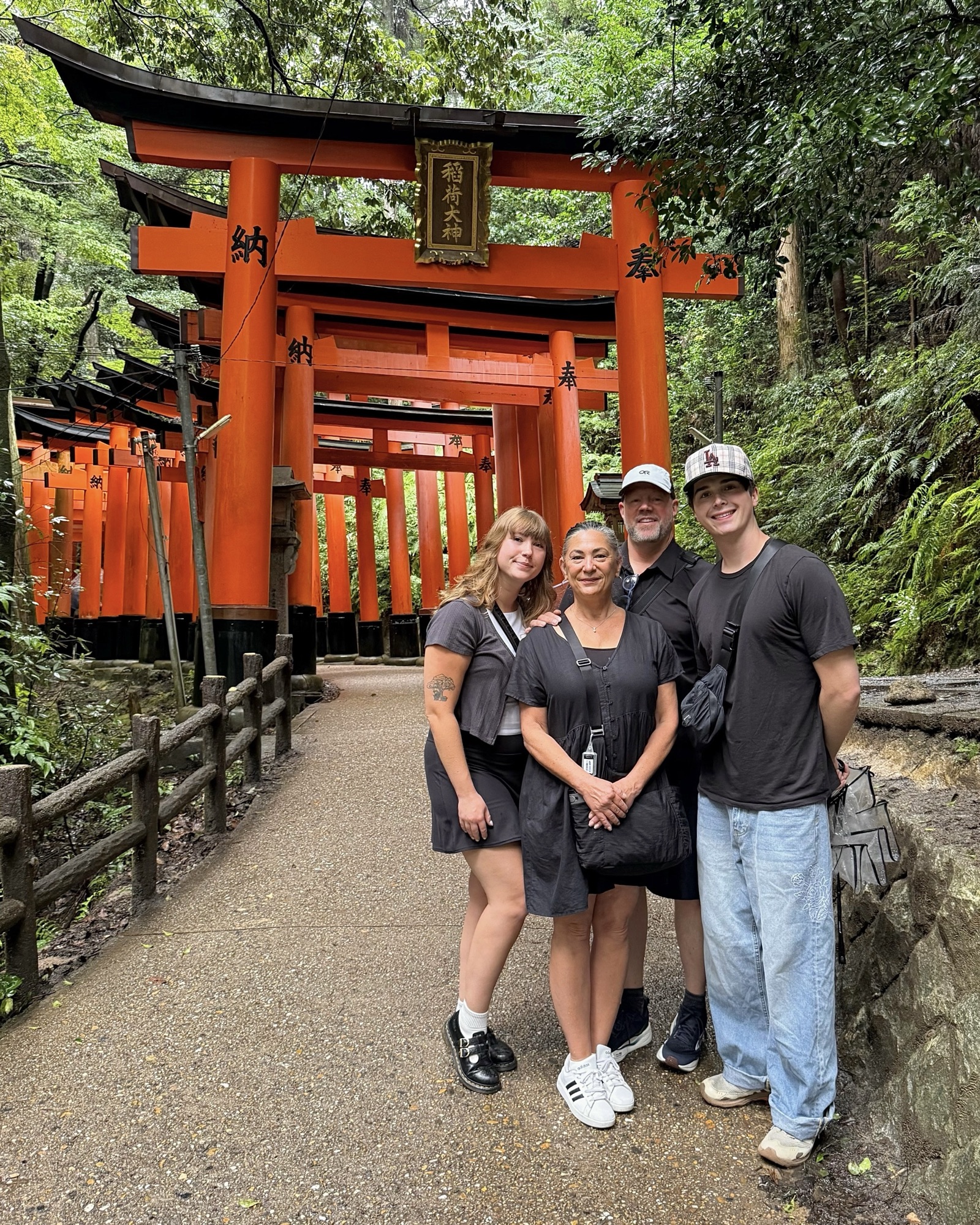
We decided not to push ourselves much further. Tomorrow required an early start, with plans to be out the door around 7:00 a.m. in an attempt to beat the Instagrammers and TikTokers to one of Japan’s most photographed places, the 10,000 torii gates at Fushimi Inari Taisha. We caught an Uber back toward the hotel and finished the evening with an excellent dinner at ROKKENN, a tiny neighborhood izakaya just a short walk from where we were staying.

Update: Upon returning to Seattle, Tawny was digging through her purse and found some crackers crumbs…



Leave a Reply